Picking the right Switching Power Supply is pretty important when you're working on electronic projects. It can really influence how well everything runs and how efficient it is. A good power supply that matches your device's needs makes a big difference in the overall performance.
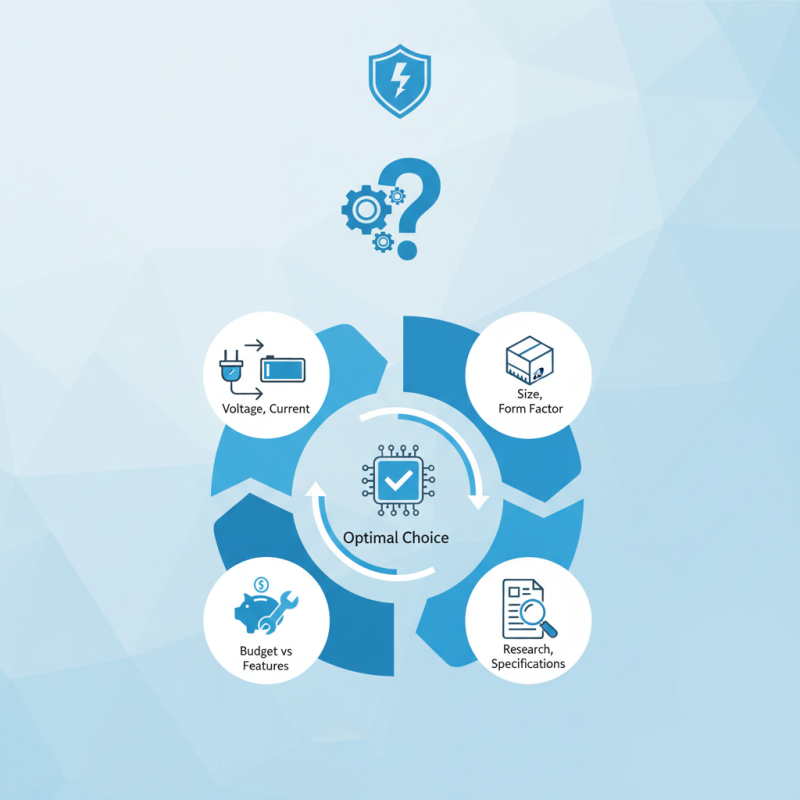
There are quite a few things to think about here—voltage, current, size, and so on. Not every Switching Power Supply will be a perfect fit for every job, and sometimes people overlook these specs a bit too casually. Picking one that's either too weak or overkill can cause all sorts of issues, like malfunctions or instability.
Doing your homework is definitely worth it. Brands like Mean Well or Delta are pretty well-known and tend to offer products you can rely on. But hey, nothing's foolproof—you'll find that no power supply is totally perfect or free from limitations. It’s all about balancing the features you need with your budget and making a cautious, well-thought-out choice.
Understanding the Basics of Switching Power Supplies
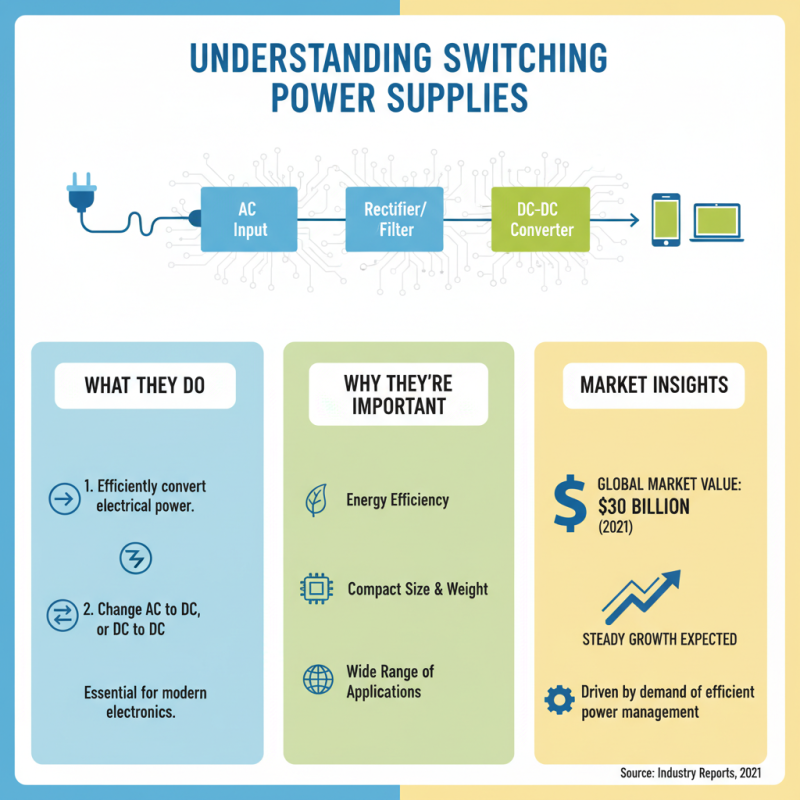
Switching power supplies (SPS) are essential in today's electronic devices. They efficiently convert electrical power from one form to another. Understanding the basics helps in choosing the right model for your needs. According to industry reports, the global switching power supply market was valued at $30 billion in 2021 and is expected to grow steadily. This reflects the increasing demand for efficient power management.
When selecting an SPS, consider several factors like voltage, current, and load regulations. The ideal voltage output may vary; for instance, many devices require 5V, while industrial applications often need 24V. It can be challenging to find a supply that meets all specifications. Reports suggest that around 30% of power supplies fail to meet performance expectations, highlighting the importance of thorough research.
Importantly, look for efficiency ratings. A supply rated over 90% efficiency reduces energy waste. Interestingly, many consumers overlook this, leading to higher operational costs. Evaluate the thermal performance as well. If poorly designed, some units can overheat, causing failures. Ultimately, understanding these basics will enable smarter decisions when selecting a switching power supply.
Key Factors to Consider in Power Supply Selection
When choosing a switching power supply, certain factors cannot be overlooked. Wattage is crucial. Determine how much power your device requires. Underestimating this can lead to poor performance. On the other hand, overestimating may result in wasted energy and cost. Aim for a power supply with a bit more wattage than your needs to ensure efficiency.
Efficiency ratings are also essential. A higher efficiency means less energy waste and lower heat production. Look for power supplies with good efficiency certifications. This can make a significant difference in long-term cost savings. Size and form factor are two other considerations. Ensure the dimensions fit your setup. Compact spaces may require smaller units, potentially limiting capacity. Don’t forget to check for proper cooling features. Poor cooling can lead to premature failures.
Lastly, pay attention to safety features. Overvoltage protection, short circuit protection, and thermal shutdown are important. These details can save your investment. While many factors come into play, neglecting even one could lead to complications. Think twice before making a decision. Errors in selection can be costly.
Key Factors in Choosing the Right Switching Power Supply
Assessing Your Power Requirements for Specific Applications
Choosing the right switching power supply starts with understanding your power requirements. For different applications, the demand can vary significantly. For example, in industrial settings, devices requiring DC power supply might need as much as 10kW. This demand often exceeds the capabilities of typical commercial supplies, making careful consideration essential.
Reports show that efficiency ratings impact the total energy costs. A unit with an efficiency of 90% uses less energy than one with 80% efficiency. Over time, this difference can lead to substantial savings. It’s crucial to factor in potential heat dissipation too. Inadequate cooling can lead to failures, affecting equipment longevity.
Understanding your load type also matters. Resistive loads, like heaters, have different characteristics compared to inductive loads, like motors. Each type could behave unpredictably when coupled with a mismatched DC power supply. This mismatch could lead to excessive energy loss or even damage. Conducting a detailed analysis of your specific application can prevent these issues.
How to Choose the Right Switching Power Supply for Your Needs?
| Application | Voltage (V) | Current (A) | Power (W) | Efficiency (%) | Form Factor |
| LED Lighting | 12 | 2 | 24 | 85 | Compact |
| Computing Devices | 19 | 4 | 76 | 90 | ATX |
| Industrial Automation | 24 | 10 | 240 | 88 | DIN Rail |
| Telecommunication | 48 | 5 | 240 | 92 | 1U Rack Mount |
| Consumer Electronics | 5 | 2 | 10 | 80 | Wall Adapter |
Evaluating Efficiency Ratings and Performance Metrics
When selecting a switching power supply, efficiency ratings play a crucial role. Higher efficiency means less energy waste. Look for power supplies that convert AC to DC with minimal losses. This can reduce your electricity costs significantly. An efficiency rating above 80% is generally acceptable, but higher ratings are preferred. If you are using a 50-1000V DC power supply, check its efficiency at different loads. Sometimes, efficiency drops at lower loads.
Performance metrics also matter. Pay attention to the load regulation and ripple voltage. Load regulation shows how well the power supply maintains output voltage under varying loads. A good power supply should not deviate significantly from its rated voltage. Ripple voltage indicates the smoothness of the output signal. Lower ripple values often translate to better performance, especially in sensitive applications.
Many users overlook these details. It's easy to focus on price or wattage alone. However, understanding these specifics can lead to more informed decisions. Bad choices can lead to equipment failure or inefficiency issues. Reflecting on past purchases can improve future decision-making. Always prioritize efficiency and performance to ensure reliability and longevity in your projects.
Exploring Different Types of Switching Power Supplies
When exploring different types of switching power supplies, it's essential to understand their unique features. There are several common types: flyback, forward, and half-bridge. Each serves a specific purpose and has its own advantages. Flyback converters are often used in low to medium power applications. They are simple and cost-effective but can struggle with efficiency at higher power levels.
Forward converters, on the other hand, provide better performance and higher efficiency. They work well for medium to high power applications. However, they can be more complex to design and implement. Half-bridge converters are typically used for high-power systems. They require more components but offer superior efficiency and power management.
Tips: Consider your specific needs before selecting a power supply type. Assess the required voltage and current. Think about efficiency and thermal management. Remember to factor in your budget. Not every type works for every application, and sometimes it’s a trial and error process to find the ideal match. If you notice overheating or inefficiencies, it might be time to reconsider your choice. Balancing cost with performance can be tricky but is crucial for optimal operation.
Selecting the Right Form Factor and Size for Your Space
When selecting a switching power supply, the form factor and size play a critical role. In various industries, size constraints are common. A compact power supply can often meet space limitations in applications ranging from consumer electronics to industrial machinery. According to a recent industry study, over 35% of engineers cite size as a key factor in their design choice. A smaller Power Supply Converter can facilitate efficient layout designs. This is especially crucial in modern devices where every inch counts.
Choosing the right form factor also affects thermal management. Larger supplies might dissipate heat more effectively, but they can make a product bulky. The ideal solution balances size and efficiency. Reports indicate that a well-chosen modular design can reduce wasted space by up to 20%. However, some may overlook the excess thermal output of smaller units. Engineers must carefully weigh the cooling needs to prevent failure.
More options are available in a variety of shapes and sizes. But this can create confusion. Not all switching power supplies fit seamlessly into designs. It’s essential to consider not just the physical size but also the mounting options. Each decision impacts overall functionality. In some instances, what seems like a fitting solution might lead to struggles later. A thoughtful approach is vital to avoid rework or performance issues in the final product.
Reviewing Safety Features and Compliance Standards
When selecting a switching power supply, safety features and compliance standards should be a primary concern. Failure to consider these factors can lead to device damage, inefficient operation, or safety risks. Safety certifications like UL, CE, and FCC ensure that power supplies meet necessary safety requirements. Reports indicate that nearly 30% of electrical fires are caused by faulty power supplies. Hence, investing in compliant units is crucial.
Another key aspect to examine is the thermal performance and over-current protection. A unit may function well initially but could fail in high-load scenarios. Continuous operation beyond specifications can shorten its lifespan. It's essential to choose models that offer built-in thermal shutdown and current limit features, as well as adequate heat dissipation options. This 'Battery-less Off-Grid Power Supply' can significantly enhance reliability.
Tip: Always verify the manufacturer's safety test reports. Look for devices that indicate they've passed rigorous testing. Compatibility with your application should also be examined. Using an unsuitable power supply can compromise the integrity of the devices it supports. In some cases, users have been reported to overlook these features, leading to unfortunate outcomes. Prioritize safety to prevent future regrets.
FAQS
: The form factor affects how the unit fits into available space. Size constraints are common in many applications.
Larger units can dissipate heat better. Smaller units may lead to overheating without proper cooling measures.
Ignoring cooling requirements can cause unit failure. It might operate well initially but fail under heavy loads.
Not every power supply fits into every design. Compatibility affects functionality and overall performance.
Look for thermal protection, over-current protection, and safety certifications. These features enhance reliability.
Faulty power supplies can lead to device damage or safety hazards. Nearly 30% of electrical fires stem from them.
Verify testing reports from manufacturers. Reliable units should indicate they passed rigorous safety evaluations.
Using an unsuitable unit may compromise device integrity. Performance issues could arise later, leading to rework.
A well-chosen modular design can minimize wasted space. This can enhance efficiency in compact applications.
Focusing on safety can prevent accidents and device malfunctions. Ignoring this could lead to regrets later.
Conclusion
Choosing the right Switching Power Supply for your needs involves a comprehensive understanding of its fundamentals. First, it's essential to assess your power requirements based on specific applications to ensure compatibility and performance. Key factors such as efficiency ratings and performance metrics play a significant role in selecting the best option, impacting not only energy consumption but also the overall longevity of your devices.
Additionally, considering the various types of Switching Power Supplies available allows for more tailored solutions, while evaluating the appropriate form factor and size ensures optimal integration into your workspace. Lastly, reviewing safety features and compliance standards is critical to guarantee reliable operation and to protect both the equipment and the user. By systematically analyzing these aspects, you can make an informed decision about the ideal Switching Power Supply for your unique requirements.